
Robbery vs burglary is a distinction that trips up almost everyone outside the legal field, yet in Minnesota these are two completely different crimes with different elements, different statutes, and very different consequences. People often use the words interchangeably, but Minnesota law treats them as separate offenses. Robbery is a crime against a person that involves taking property by force or threat, prosecuted under Minn. Stat. §§ 609.24 and 609.245. Burglary is a crime involving unlawful entry into a building with intent to commit a crime, prosecuted under Minn. Stat. § 609.582. You can commit burglary without ever confronting another person, and you can commit robbery without ever entering a building. Understanding these differences matters enormously because the charge you face determines your penalties, your defenses, and your future. This guide breaks down the four key legal differences between robbery and burglary in Minnesota.
- What each crime actually is: Plain-English definitions of Minnesota robbery and burglary.
- Four key differences: The specific ways these two Minnesota crimes differ in elements and proof.
- The penalties involved: Prison ranges and defenses for both robbery and burglary charges in Minnesota.
How Minnesota Defines Robbery and Burglary
Robbery and burglary are separate crimes in Minnesota with different statutes and different core elements. The simplest way to remember the difference: robbery is about taking property from a person by force, while burglary is about illegally entering a building to commit a crime.
What Is Robbery Under Minnesota Law?
Robbery is a crime against a person that involves taking property directly from someone, or in their presence, using force or the threat of force. Under Minn. Stat. § 609.24, simple robbery occurs when a person takes property from another person and uses or threatens the imminent use of force to overcome resistance or compel the person to give up the property. The key elements are the presence of a victim, the taking of property, and the use or threat of force. Robbery always involves a direct confrontation between the offender and the victim. Aggravated robbery under Minn. Stat. § 609.245 adds a dangerous weapon or bodily harm, increasing the penalties significantly.
- Crime against a person: Robbery always involves a victim who is present.
- Force or threat: The taking must involve force or the threat of imminent force.
- Direct confrontation: There is always a face-to-face interaction with the victim.
- Property taken: The offender takes property from the person or in their presence.
What Is Burglary Under Minnesota Law?
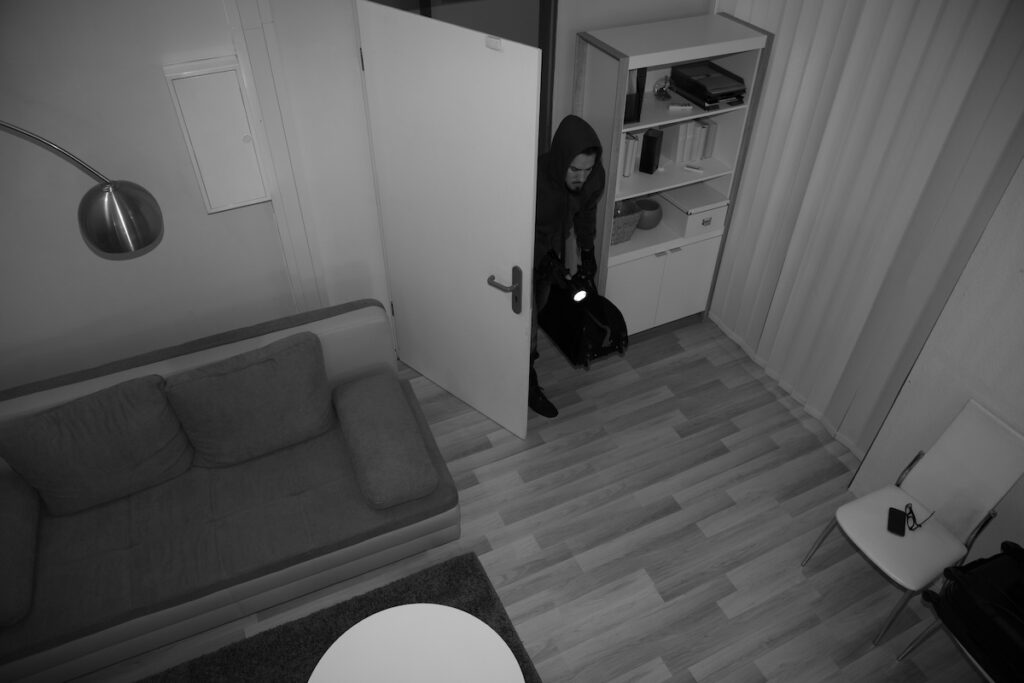
Burglary is a crime involving unlawful entry into a building with intent to commit a crime inside. Under Minn. Stat. § 609.582, burglary occurs when a person enters a building without consent and either intends to commit a crime while inside or actually commits one. Unlike robbery, burglary does not require a victim to be present, does not require any force against a person, and does not even require anything to be stolen. The core elements are unauthorized entry into a building and criminal intent. Minnesota divides burglary into four degrees based on factors like whether the building was a dwelling, whether anyone was present, and whether a weapon or assault was involved. A person can commit burglary by slipping into an empty house through an unlocked door.
- Crime involving a building: Burglary requires unlawful entry into a structure.
- No victim needed: Nobody has to be present for burglary to occur.
- Criminal intent: The person must intend to commit a crime inside (or actually commit one).
- No force against a person: Burglary does not require any confrontation or violence.
4 Key Differences Between Robbery and Burglary in Minnesota
The four differences below capture the most important distinctions between robbery and burglary under Minnesota law. Each one affects how a case is charged, what the prosecution must prove, and what penalties apply.
1. Crime Against a Person vs Crime Involving a Building
The most fundamental difference is what each crime targets. Robbery is a crime against a person, meaning it requires a human victim from whom property is taken through force or threat. Burglary, by contrast, is a crime involving a building or structure, meaning it centers on the unauthorized entry into a place rather than a confrontation with a person. This distinction shapes everything else about the two crimes. In a robbery case, the prosecution must prove there was a victim who was confronted and had property taken. In a burglary case, the prosecution must prove there was an unlawful entry into a building with criminal intent, but there does not need to be any victim present at all. This is why an empty-house break-in is burglary while a street mugging is robbery.
- Robbery targets a person: A human victim must be present and confronted.
- Burglary targets a place: The crime centers on unlawful entry into a building.
- Different proof required: Robbery needs a victim; burglary needs an unlawful entry.
- Classic examples: A street mugging is robbery; an empty-house break-in is burglary.
2. Force and Confrontation vs No Confrontation Needed
The second key difference is whether force or confrontation is required. Robbery always requires the use or threat of force against a person. Without force or the threat of imminent force, taking property is theft, not robbery. This confrontation element is what makes robbery so serious, because it places a victim in fear or physical danger. Burglary, on the other hand, requires no force against any person and no confrontation at all. A burglary can be completely non-violent, such as sneaking into an unoccupied building. The presence or absence of force and confrontation is often the dividing line between which charge applies and how severe the penalties are. When a burglary does involve confrontation or assault, it can be elevated to first-degree burglary, and separate assault or robbery charges may also apply.
According to the Minnesota Office of the Revisor of Statutes, Minn. Stat. § 609.24 provides that a person commits robbery when they take property and “use or threaten the imminent use of force against any person to overcome the person’s resistance or powers of resistance to, or to compel acquiescence in, the taking or carrying away of the property,” and may be sentenced to imprisonment for not more than ten years, confirming that force or the threat of force is an essential element that separates robbery from other property crimes.
- Robbery needs force: Force or threat of imminent force is a required element.
- Burglary needs no force: A burglary can be completely non-violent.
- Force distinguishes theft: Taking property without force is theft, not robbery.
- Overlap possible: A burglary involving confrontation can add robbery or assault charges.
3. Presence of a Victim vs an Empty Building
The third difference is whether a victim must be present. Robbery, by definition, requires a victim to be present because the property is taken from the person or in their presence by force. There is no such thing as robbery of an empty room. Burglary can happen whether or not anyone is present in the building. In fact, many burglaries are specifically committed when the building is empty to avoid confrontation. The presence of a person during a burglary actually increases its severity: under Minn. Stat. § 609.582, Subd. 1, burglary of a dwelling when another person is present is first-degree burglary, the most serious form. This difference in the role of the victim is central to how the two crimes are charged and defended.
- Robbery requires a victim: Property is taken from a person who is present.
- Burglary can be victimless: Many burglaries target empty buildings.
- Presence raises burglary severity: An occupied dwelling makes burglary first-degree.
- Different victim role: The victim is central to robbery but not required for burglary.
4. The Charges, Degrees, and Penalties Differ
The fourth difference is in how each crime is graded and punished. Robbery has three levels: simple robbery under Minn. Stat. § 609.24 (up to 10 years and a $20,000 fine), second-degree aggravated robbery under Minn. Stat. § 609.245, Subd. 2 (implying a weapon, up to 15 years and a $30,000 fine), and first-degree aggravated robbery under Minn. Stat. § 609.245, Subd. 1 (actual weapon or bodily harm, up to 20 years and a $35,000 fine). Burglary has four degrees under Minn. Stat. § 609.582, ranging from first-degree (up to 20 years and $35,000) down to fourth-degree (a gross misdemeanor with up to 364 days in jail). While the top penalties are similar, the paths to get there and the elements the state must prove are completely different for each crime.
- Robbery has three levels: Simple, second-degree aggravated, and first-degree aggravated.
- Burglary has four degrees: First through fourth, ranging from felony to gross misdemeanor.
- Similar top penalties: Both first-degree aggravated robbery and first-degree burglary reach 20 years.
- Different elements: The proof required for each crime is entirely different.

Defenses and Overlap Between Robbery and Burglary
Although robbery and burglary are distinct crimes, they can overlap in a single incident, and both are frequently defendable in Minnesota courts. Understanding how the charges interact and what defenses apply is essential for anyone facing either accusation.
Can You Be Charged With Both Robbery and Burglary?
Yes. A single incident can result in both robbery and burglary charges if the facts support both crimes. For example, if a person breaks into an occupied home (burglary) and then confronts and forcibly takes property from a resident (robbery), Minnesota prosecutors can charge both offenses. This is common in home invasion cases, where the unlawful entry supports a burglary charge and the confrontation with residents supports a robbery charge. When both charges apply, the penalties can stack, dramatically increasing the potential prison time. This is one reason home invasion cases are among the most serious property crimes in Minnesota, and why anyone facing these charges needs experienced defense representation immediately.
- Both can apply: A single incident can support robbery and burglary charges together.
- Home invasions: Breaking in plus confronting residents often triggers both charges.
- Stacking penalties: Multiple charges can dramatically increase prison exposure.
- Serious cases: Combined robbery and burglary charges require aggressive defense.
What Defenses Apply to Robbery and Burglary Charges?
Common defenses to robbery focus on attacking the force element (arguing no force or threat was used, which could reduce the charge to theft), challenging identification, and disputing whether property was actually taken. Common defenses to burglary focus on the intent element (arguing there was no intent to commit a crime), the consent element (arguing the person had permission to enter), and challenging identification. For both crimes, defense attorneys also file motions to suppress evidence obtained through illegal searches, challenge unreliable witness testimony, and negotiate for reduced charges. In many cases, a skilled defense attorney can reduce an aggravated robbery to simple robbery, or a felony burglary to a lesser charge, by attacking the specific elements that elevate the offense.
- Robbery defenses: Attacking the force element can reduce robbery to theft.
- Burglary defenses: Challenging intent or showing consent can defeat a burglary charge.
- Suppression motions: Illegally obtained evidence can be excluded for both crimes.
- Charge reduction: Skilled defense can reduce aggravated charges to lesser offenses.
Frequently Asked Questions
What is the main difference between robbery and burglary in Minnesota?
The main difference is that robbery is a crime against a person involving force or threat to take property, while burglary is a crime involving unlawful entry into a building with intent to commit a crime. Robbery always requires a victim and confrontation; burglary requires neither. You can commit burglary in an empty building and robbery without ever entering a building.
Is robbery or burglary a more serious charge in Minnesota?
It depends on the specific circumstances. First-degree aggravated robbery and first-degree burglary both carry up to 20 years in prison. However, simple robbery (up to 10 years) is generally treated as more serious than third or fourth-degree burglary (up to 5 years or a gross misdemeanor). The severity depends on weapons, injuries, and whether a dwelling or victim was involved.
Can shoplifting become robbery in Minnesota?
Yes. Shoplifting is normally charged as theft, but if the shoplifter uses force or threats against a store employee or security guard (for example, to escape or keep the merchandise), the charge can be elevated to robbery. This is sometimes called “shoplifting turned robbery” and dramatically increases the potential penalties from a misdemeanor theft to a felony robbery.
Do I have to steal something to be charged with burglary?
No. Burglary requires only unlawful entry into a building with intent to commit a crime, or actually committing a crime inside. You can be convicted of burglary even if you never took anything, as long as the prosecution proves you entered without consent and intended to commit a crime inside. The intended crime does not have to be theft.
What is home invasion in Minnesota?
Minnesota does not use the exact term “home invasion” as a separate crime, but the conduct is typically charged as first-degree burglary (entering an occupied dwelling) often combined with aggravated robbery, assault, or other charges. Home invasion cases are among the most serious property crimes and frequently result in multiple stacked felony charges with lengthy prison exposure.
Can robbery or burglary charges be reduced or dismissed?
Yes. Experienced Minnesota defense attorneys regularly reduce or dismiss these charges by attacking the specific elements (force for robbery, intent and consent for burglary), challenging identification and witness reliability, and suppressing illegally obtained evidence. Aggravated robbery can often be reduced to simple robbery, and felony burglary can sometimes be reduced to a lesser charge through skilled negotiation.

Defend Your Future With The Law Offices of Josh Johnson
Robbery and burglary are two of the most serious property crimes in Minnesota, and understanding exactly what you are charged with is the first step toward building a strong defense that protects your freedom and your future. The Law Offices of Josh Johnson defends clients against robbery and burglary charges across Hennepin, Ramsey, Dakota, Anoka, and Washington counties, combining detailed knowledge of Minn. Stat. §§ 609.24, 609.245, and 609.582 with a strategic approach that challenges every element the prosecution must prove. Josh Johnson personally reviews every case to identify weaknesses in the state’s evidence, attacks the force and intent elements that separate serious charges from lesser ones, and pursues every path from dismissal to charge reduction to acquittal. If you are facing robbery, burglary, or combined home invasion charges anywhere in the Twin Cities area, contact The Law Offices of Josh Johnson today for a free, confidential consultation and find out what defenses apply to your case before the state builds its case any further.
